Overview
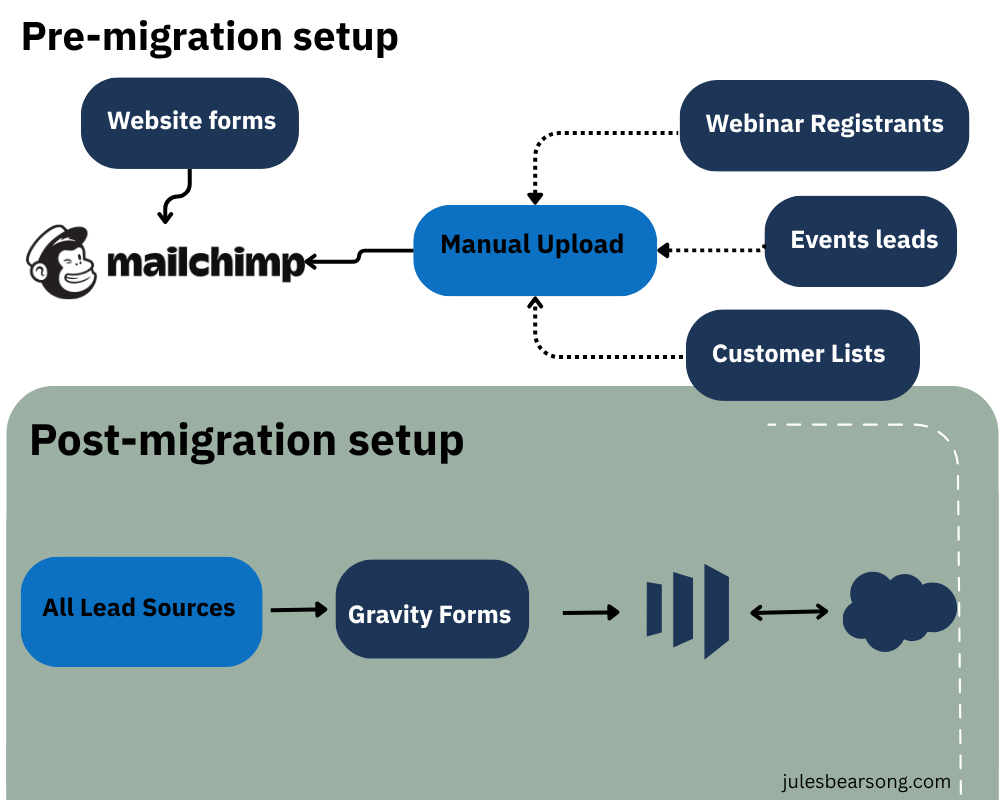
A small educational technology company hired me to take over email marketing strategy. A big part of this included, migrating platforms from MailChimp to Marketo.
The company didn’t have a well-established marketing team at the time. I was the third member of the team! Although there was no formal strategy (yet), we had an impressive list and an engaged audience.
I came in to execute a migration from Mailchimp to Marketo of a database containing over 250,000 engaged contacts. The team was small, and the company had other priorities—specifically setting up a new Salesforce instance. So I had roughly six months to complete this project, including full IP Warming.
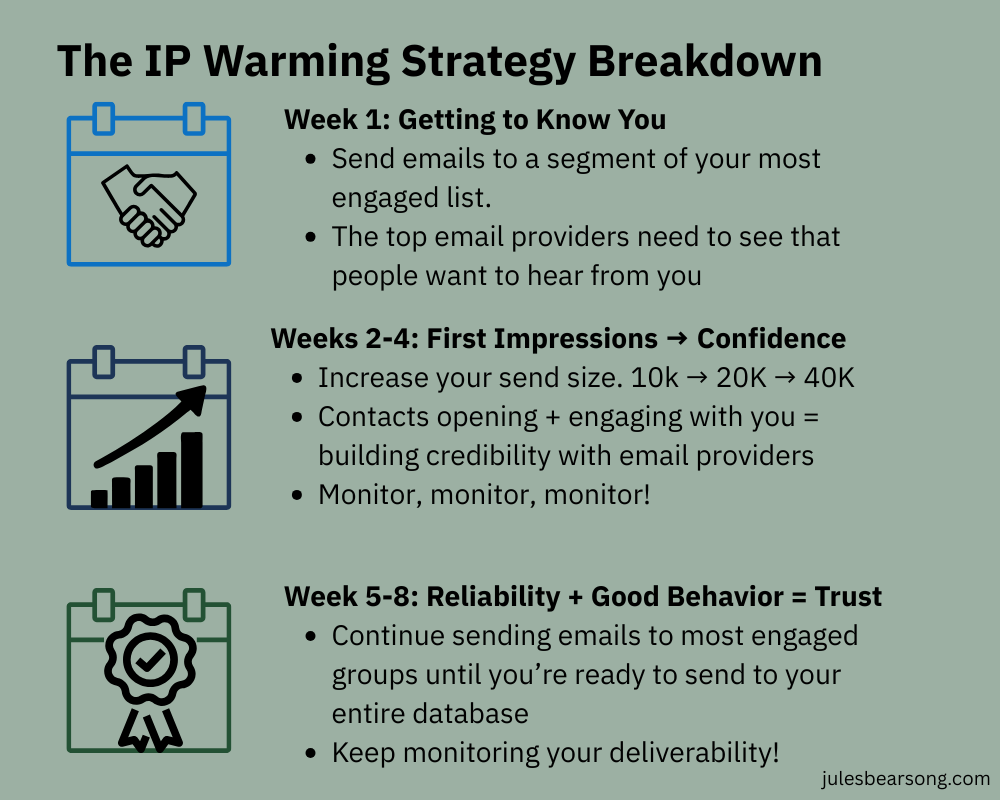
Note: IP warming is a process of sending emails to small groups of engaged people to show email providers that you’re trustworthy. Over time, you increase the number of people in your sends until you can send emails to your entire list at once.
Highlights:
- Migrating 250K+ database of engaged users from MailChimp to Marketo and successfully completing IP Warming in 6 Months
Constraints:
- Limited resources: We were a small team of Marketers. My manager and myself the only ones with email platform experience.
- Limited time + resources from other teams: The company was largely focused on implementing Salesforce.
Challenge & Objectives
My vision for this project was to build a system that would scale with the company. I wanted something that would enable major email marketing initiatives. Plus, it needed to align sales and marketing on the lead lifecycle journey. What a tall order!
Here’s what I was working with: MailChimp is limited in the automations you can run, and the company only had two flows…
- A quick welcome nurture flow
- A flow specific to a seasonal event (Meaning it wasn’t on for 3/4s of the year…
My short-term goals were to:
- Setup Marketo in conjunction with the Salesforce implementation. Ensuring that data flowed from Salesforce to Marketo
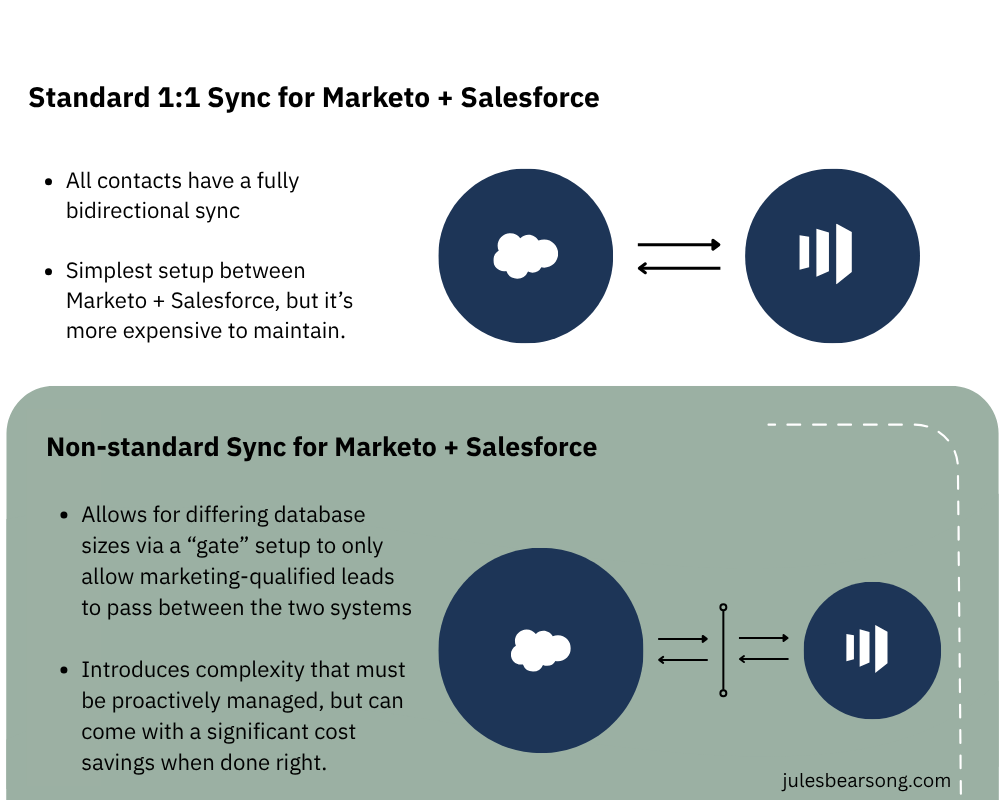
- Set up a non-standard sync for Salesforce and Marketo. We signed up for a 300K database with Marketo, but our Salesforce instance was much larger. We couldn’t have a 1:1 set up without major costs.
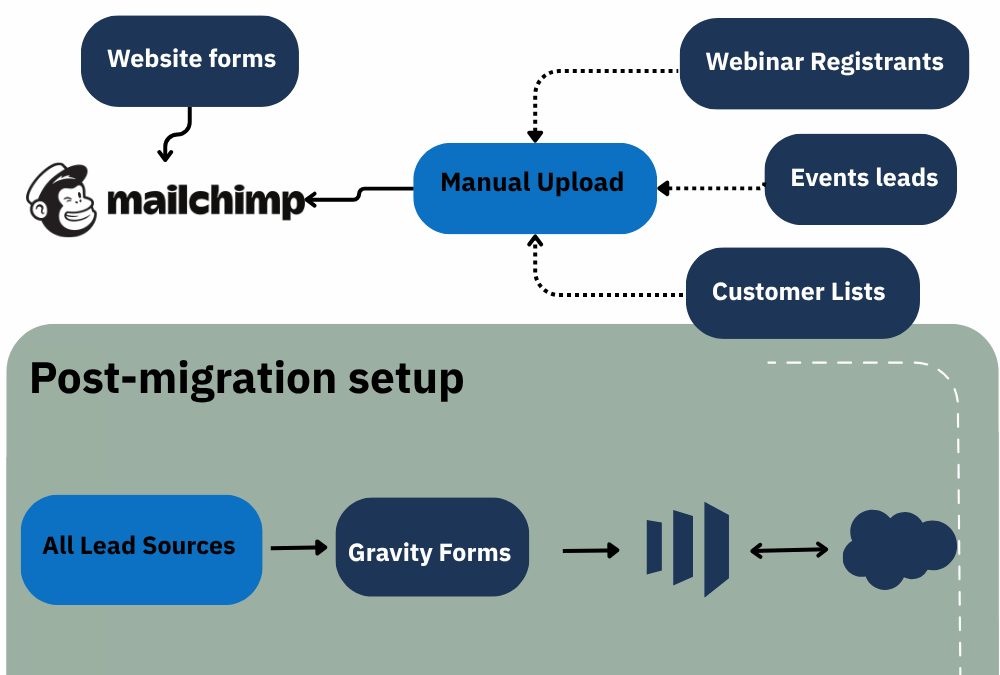
- Ensure that all forms on the site were set to send contacts to Salesforce and sunset the use of MailChimp
- Complete IP warming successfully, setting up our sender reputation for success for the future
Note: In a typical setup, Marketo and Salesforce would talk to each other about all contacts/leads. For a non-standard set up, you set up a gate on the Salesforce side to keep Marketo from accepting too many contacts into the database.
My long-term goals were to:
- Setup nurture campaigns for each of the major product lines to move contacts through the funnel
- Move webinar registrations to the Zoom/Marketo integration. This allowed us to sync contacts to Salesforce instead of the manual upload process the team had been doing.
- Build out the lead lifecycle and provide the Sales team with Sales Accepted Leads (SALs) they could then convert to opportunities and sales
Approach & Process
When approaching any project, you have to first make sure you understand the end goal and all the pieces and players involved.
For me as a new hire, this meant getting to know the other teams, what their needs were, and what systems we would be working with. This also meant bringing in help from teams more experienced than myself in the initial setup of Marketo, something that was new to me!
I spent time with our Marketing Director and Sales Director to get alignment on what was needed. And worked closely with the Vendor we chose to help us set up our instance, as well as our own developer contractor and Salesforce Administrator. That’s a lot of people involved, but you cannot do this key work in a silo, even as the executor and owner of a project!
A few key decisions we made:
- Setting up the non-standard sync between Salesforce and Marketo. Hygiene strategy becomes critical when you choose to limit how Salesforce and Marketo interact. But it’s also necessary when you have database size limits that don’t match! This is one I’d had experience with before so I was able to speak to the limitations there.
- Using Gravity Forms instead of native Marketo forms on our website. The sales team wanted to auto-populate district information to tie new contacts to the correct accounts. The dataset was too large for Marketo forms to handle, so we had to make that tradeoff which complicated lead flows to a degree.
Tools & techniques:
Data Cleanup & Governance
Excel was my best friend for this project. Before this project, MailChimp and the CRM system were not connected. So when Salesforce was implemented it had a contacts database already to work with. This meant exporting out my MailChimp contacts and Salesforce contacts. I then used Excel to connect the dots before pushing contacts into the new system.
IP Warming Considerations:
For IP Warming, I needed to clearly label contacts according to their level of engagement. I broke segments out into:
- 30 days engaged,
- 60-days engaged,
- 90-days engaged,
- followed by everyone else.
Because we were warming up the IP slowly, I built out newsletters and emails in both MailChimp and Marketo. This allowed me to ensure that no one was getting the email twice. It also ensured I was keeping all engaged contacts warm.
I also had to work with our Salesforce admin to ensure that people who unsubscribed were unsubscribed in all systems.
In all this, I cannot emphasize the power of clear and frequent communication. This was such a smooth process with all stakeholders because it was clear who owned what system and who was owning this project (me in this case)
Execution & Results
In the end, I delivered a clean database that went through IP warming successfully! Our IP Warming Specialist at Marketo was very pleased with how well our plan went and how few flags there were during our process.
Once we got this in place, I was then able to move our Zoom webinars over to the Marketo integration. I went on to develop 6+ high performing nurtures with 19+% click-to-open rates. I installed a strong data hygiene program that I designed myself. And marketing efforts were able to grow the database consistently at a rate of 15K per month. We ended up needing to increase our database size twice over my time at the company.
There were challenges along the way.
- Keeping up with as complicated an IP Warming plan meant, I had to be organized and collaborate with my key partners.
- IP Warming crossed over some holidays in an industry that doesn’t favor emails during that time of year!
As Marketing was new to this company, there also were a lot of areas where I needed to step in. We often had to educate others about the importance of email marketing to the strategy. Share with non-technical stakeholders what I needed to do and why was a key part of the day-to-day.
In the end, our Marketing Director (and later CMO) said it was the smoothest migration she had ever been a part of. Considering all the migrations I’ve been a part of before and after this project, I agree!
Growth & Reflection
This was a serious test of skills, technical chops, collaboration and project management for me. When I look back at the support I received from our then Director, I’m blown away. She really let me loose on this project, supported me where needed, and stepped back to let me do my thing.
Of course, looking back there are always lessons to learn and things I’d do differently.
For one, I’d insist on more Sales alignment in the beginning. The Sales team typically didn’t have the technical know-how to express what they needed. I should have broken things down early for them, showed them more of the possibilities, and let them in a little on how the process works so they could get creative.
I’d also have done more background research for the Sales Team and presented them with more options. Some of the decisions that were made by the Sales Director had negative impacts on how prospects flowed through to the Sales Team. It’s not something I blame them for at all!
If you don’t know, you don’t know.
It wasn’t a realm I was familiar with either. But I had more of an understanding of the tech than they did, so stepping in earlier would have made for stronger long-term impacts.
This definitely shaped my thought processes on big projects that move the needle. I’m a fan of having a strong plan, but the setup is just as important as the ongoing implementations.
My philosophy become: plan early, get buy-in (and then get some more!), collaborate, communicate more, and execute.
Final Thoughts
This project ended up becoming the foundation for so much of the work we did on the marketing team. Beyond webinars, events, and nurture programs it became the backbone of the lead lifecycle programs. Allowing for the clean flow of data from website to CRM should be the pride of any operational marketer!
I wrote earlier about that need for marketing education and how I’d introduce it sooner if I went back. When we caught up, the marketing team was fielding more requests from customer success and sales than we could handle.
Empowering teams is what operations is all about. And showing people what’s possible opens up so many doors to new opportunities.
Recent Comments